
The operating model for biotech and health tech startups has shifted decisively. Where founders once built internal manufacturing capability, regulatory teams, and supply chains as a marker of legitimacy, the most capital-efficient companies now outsource these functions entirely. This represents not a cost-cutting measure but a strategic pivot toward what founders can do best: identifying unmet clinical need and building diagnostic or therapeutic platforms around it. The shift is reshaping how women-led companies in precision health enter the market, access capital, and scale globally.
Two parallel developments illustrate this transition. Juno Bio, a women-founded vaginal microbiome testing company, raised $3.8 million and opened its own CLIA-certified sequencing lab in Oakland, California, signaling readiness to scale clinical capacity. Meanwhile, the broader biotech sector has moved decisively toward contract development and manufacturing organizations (CDMOs) as the default path for early-stage companies. This split reflects a fundamental truth: outsourcing works for therapeutic manufacturing, but diagnostic platforms require proprietary lab infrastructure and data ownership. For women founders navigating venture capital and strategic partnerships, the difference matters enormously.
The Economics Of Manufacturing Outsourcing Drive Industry Structure
Building a good manufacturing practice (GMP) facility costs $200 million or more and requires three to five years to commission. For a biotech company operating on Series B funding with a single molecule in Phase 1 clinical trials, this math does not work. Even well-funded companies with multiple programs now choose outsourcing because the complexity of modern drug manufacturing exceeds what a lean biotech team can manage internally.
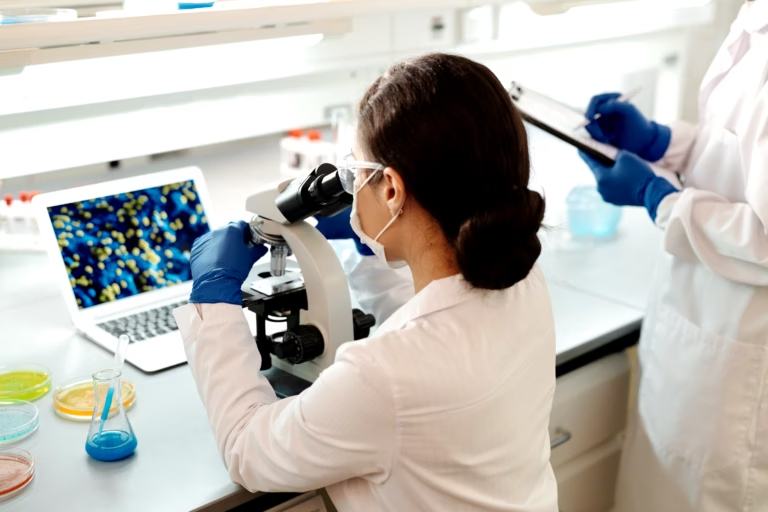
According to 2025 Pharma Manufacturing analysis, 73% of FDA-approved drugs outsourced their active pharmaceutical ingredient manufacturing, the highest rate ever recorded. For biotech firms specifically, that figure approaches 90%. The drugs entering development today are structurally complex and analytically demanding. Peptide therapeutics, which have surged in demand following the GLP-1 revolution, require solid-phase synthesis with specialized building blocks, multi-step purification, and regulatory filings under frameworks that did not exist when most biotech founders began their careers.
The modalities driving outsourcing are the same ones creating the biggest therapeutic breakthroughs. GLP-1 agonist programs, antibody-drug conjugates, oligonucleotides, and high-potency small molecules all require infrastructure that most biotech firms will never build. Companies succeeding in this environment choose CDMO partners early and treat those relationships as strategic rather than transactional. For women-led firms competing for venture capital, this shift reduces the capital intensity of entry and allows founders to remain focused on science and clinical strategy rather than facility operations.
Diagnostic Platforms Require Different Infrastructure And Capital Models
Juno Bio’s path diverges from the outsourcing trend because its business model depends on proprietary lab capacity and data ownership. The company, co-founded by Hana Janebdar and Leighton Turner, PhD, opened a CLIA-certified sequencing lab designed specifically for women’s health diagnostics. The lab analyzes approximately 10,000 bacteria and fungi along with four common STIs, identifying microbes associated with co-infections, subclinical conditions, and broader microbiome patterns.

This infrastructure decision reflects a clinical and commercial opportunity. Juno Bio found that 67.5% of its customers had been incorrectly diagnosed before using the company’s test, and only 13% had been successfully treated through conventional care. Roughly half of users experience co-infections, which traditional testing often misses but which significantly affect treatment outcomes. By building its own lab, Juno Bio controls the analytical methods, owns the underlying data, and can integrate results with telehealth and pharmacy partners more seamlessly.
The company has sold more than 20,000 tests and built one of the largest repositories of vaginal microbiome data. It evolved from a wellness test into a clinical platform with pharmaceutical research and development partnerships and a network of medical advisors including Anna Powell, MD, of Johns Hopkins. The $3.8 million raise, with backing from Ada Ventures, Artesian, Entrepreneur First, and Illumina Accelerator, positions Juno Bio to expand its test availability beyond 46 U.S. states and scale its in-house diagnostic capacity.
Access To Capital And Strategic Support Remains Critical For Women Founders
Women entrepreneurs building health tech and biotech companies operate within broader funding inequities. The capital gap for women-led startups persists across sectors, and health tech represents both an opportunity and a test case for whether new funding structures can close that gap at scale.
The Cartier Women’s Initiative, marking its 20th anniversary in 2026, demonstrates one model for sustained, long-term support. The program has evolved from five laureates to supporting 30 fellows annually across nine regional awards plus a thematic Science and Technology Pioneer Award. Over two decades, Cartier has disbursed $14.1 million in grant funding, but the program emphasizes financial support as one component of a three-part structure. The other components are human capital, through partnership with INSEAD providing education, coaching, and workshops, and social capital through community and ongoing mentorship among fellows.
For women-led biotech and health tech companies, this ecosystem-level support matters. The combination of early-stage capital, strategic guidance, and peer networks reduces the isolation that can constrain founder decision-making, particularly around capital structures, partner selection, and international scaling. Juno Bio’s funding included participation from Illumina Accelerator, suggesting that diagnostic platforms built around underserved clinical populations can attract strategic partners within larger life sciences ecosystems.
What Remains Uncertain For The Next Phase
The shift toward outsourced manufacturing and proprietary diagnostic infrastructure creates distinct pathways for different biotech business models, but questions persist about sustainability and competitive moat. For therapeutic companies, CDMO relationships are now standard, which means competing on molecule quality, clinical data, and regulatory execution rather than manufacturing control. For diagnostic platforms like Juno Bio, owning the lab creates advantage in data accumulation and integration, but it also locks capital into infrastructure that competitors could replicate with sufficient funding.
Regulatory environment matters enormously. Women founders building diagnostic platforms must navigate FDA guidance on laboratory-developed tests, which remains unsettled. Therapeutic outsourcing is now established, but diagnostic regulation is still evolving. Success will depend on whether founders can build clinical evidence fast enough to establish standard-of-care status before regulatory frameworks tighten or competitors with larger capital bases enter the space.
The broader question is whether the shift toward specialized, outsourced models in biotech actually expands opportunity for women founders or simply creates a new set of gatekeepers. Early evidence from Juno Bio and the sustained support mechanisms like the Cartier Women’s Initiative suggests that women founders are building durable companies within these new structures, but the sample remains small and the track record incomplete.
—