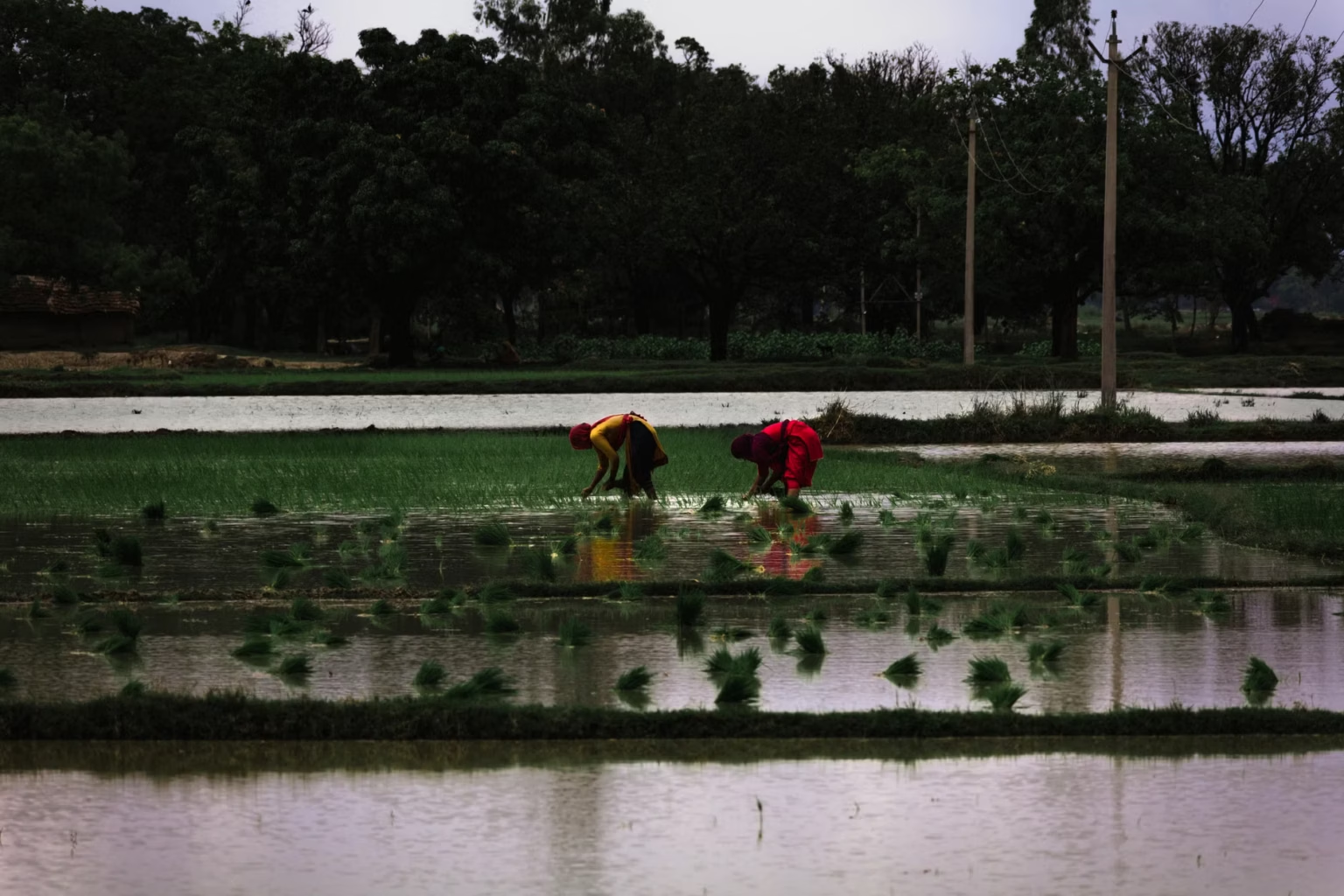
Women-led cooperatives and targeted business development programmes are generating tangible revenue growth and employment across emerging markets, signalling a shift from rhetoric toward sustained economic participation. In India’s northeastern state of Meghalaya, a farmer-producer company majority-owned and operated by women has scaled annual revenue to over Rs 1.17 crore by 2025, up from Rs 1.5 lakh in prior years. In Nigeria, a hospitality company has graduated over 60 women entrepreneurs from a tailoring and business skills programme since 2016. These developments reflect a narrower but measurable pattern: structured training, equipment provision, and market linkages enable women to move from informal activity into documented business operation.
The revenue growth at Jirang Organic Agro Farmers Producer Company in Ri-Bhoi district emerged from neither subsidy nor donation, but from production scaling and market positioning. The company, founded in 2017, now encompasses 433 farmers across 18 villages, with nearly 75 percent membership held by women. Leadership by individuals such as Ibalahun Thangkhiew and Daisy Wahlang has directed the organisation toward value-added products, notably Meghalaya’s GI-tagged pineapples, Khasi Mandarin oranges, and ginger. Government support for value addition and strategic buyer partnerships expanded market access beyond domestic channels. The company’s trajectory illustrates a critical condition: women’s economic advancement at scale requires both individual capability and ecosystem infrastructure-neither alone is sufficient.
Skills Transfer and Equipment as Economic Entry Points
In Nigeria, Transcorp Hotels Plc‘s Business Empowerment Programme for Women takes a direct approach to entrepreneurial activation. The six-month curriculum covers tailoring, business fundamentals, financial management, marketing, and customer service. Upon graduation, participants receive sewing machines and tools, removing a common barrier to immediate business launch. The company reports that 64 women have completed the programme since its 2016 inception through partnership with ACE Charity. The 16th cohort graduated in 2024, with no stated revenue figures or employment outcomes disclosed by the company.

The equipment transfer model addresses a practical bottleneck: many prospective entrepreneurs lack capital for machinery. Providing machines at programme completion shortens the transition from training to revenue. However, the long-term survival rate and profitability of businesses launched post-graduation remain undocumented in available reports. The Transcorp initiative also incorporates a sustainability angle, repurposing pre-used hotel bedding for training materials, modelling circular economy practice. Whether this sustainability focus adds competitive value for the graduated entrepreneurs or remains primarily a corporate messaging function is unclear from available information.
Market Positioning and Strategic Partnerships Drive Scale
The Meghalaya cooperative’s success points to a distinct advantage over isolated individual entrepreneurs: collective market power. By consolidating 433 farmers’ production, the organisation achieved sufficient volume and consistency to secure premium buyer relationships and government export pathways. Export of GI-tagged products to both domestic and international markets demonstrates that authentic product differentiation, supported by formal geographic indication status, carries market weight. The partnership model-combining community ownership, government investment in infrastructure, and private buyer commitments-creates a structure individual women entrepreneurs cannot easily replicate alone.
This stands in contrast to the individual tailor or small-scale producer operating without cooperative backing or formal market channels. Women entrepreneurs frequently report access barriers in capital, supplier networks, and formal procurement systems, challenges that cooperative structures partially mitigate through aggregation and institutional credibility.
Accountability and Measurement Gaps
Despite growth announcements, critical measurement remains sparse. The Jirang cooperative discloses revenue and membership numbers but provides no breakdown of per-farmer income, profitability margins, employment created, or attrition rates. The Transcorp programme reports graduate numbers and equipment distribution but lacks published data on business survival, average revenue per graduate, or loan repayment rates among alumni. These gaps matter because they prevent assessment of whether programmes generate sustainable livelihood change or temporary activity injection.
For policy and investment purposes, the distinction is material. A programme that trains 64 women but results in 40 percent business failure within two years produces different social and economic outcomes than one with 80 percent survival. Revenue aggregates at the organisation level can mask wide variation in individual benefit. Without transparent outcome reporting, claims of “empowerment” and “economic inclusion” remain difficult to verify against actual participant experience.
Institutional Support as a Scaling Condition
The Jirang FPC’s expansion benefited from deliberate government support for value-addition infrastructure and market access. This institutional backing-essentially public investment in cooperative capacity-differs markedly from ad-hoc corporate training programmes. When public systems invest in farmer cooperatives, the sustainability model assumes state interest in replicating success. Corporate programmes, by contrast, operate as discretionary initiatives subject to business strategy shifts.
Regional policy frameworks increasingly recognize women’s economic participation as both a development and financial sector priority, creating openings for structured public-private partnerships. India’s agricultural export policy and EU initiatives in emerging markets signal that institutional actors are willing to invest in women-led supply chains when revenue potential and export volume justify the outlay.
The evidence from both Nigeria and India suggests that women-led enterprises reach measurable scale when three conditions align: structured skills transfer, access to capital or equipment, and linkage to formal markets or procurement systems. Individual programmes addressing one or two of these conditions produce activity but limited durability. Cooperatives and aggregation models that combine all three show steeper growth curves. Yet outcome measurement remains inconsistent, limiting the ability to assess which programme model returns greatest impact per dollar invested.
Frequently asked questions
What revenue growth has the Jirang Organic Agro Farmers Producer Company achieved?
The company scaled annual revenue to over Rs 1.17 crore by 2025, up from Rs 1.5 lakh in previous years, while serving 433 farmers across 18 villages with nearly 75 percent women membership. The company scaled annual revenue to over Rs 1.17 crore by 2025.
How does Transcorp Hotels support women entrepreneurs through its training programme?
The Business Empowerment Programme provides six months of tailoring and business skills training, including financial management, marketing, and customer service, followed by equipment donation to enable immediate business launch. The Business Empowerment Programme provides six months of tailoring and business skills training.
What institutional factors drive cooperative success compared to individual entrepreneurs?
Cooperative models achieve scale through aggregated production volume, formal market channels, GI product certification, and government infrastructure support-conditions individual entrepreneurs cannot easily replicate independently. Cooperative models achieve scale through aggregated production volume.
What measurement gaps exist in women entrepreneur programmes?
Published reports typically disclose aggregate revenue and graduate numbers but lack per-participant income data, business survival rates, profitability margins, or long-term outcome tracking. Published reports typically disclose aggregate revenue and graduate numbers.