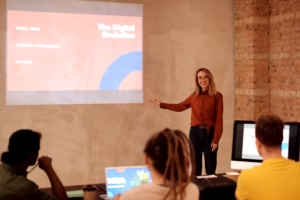
Three women executives speaking at the National Retail Conference and Expo last week offered unusually specific guidance on what separates durable leadership from short-term performance: integrity, direct listening, and cultural fluency.
Their remarks centered on a shared conviction that sustainable business growth depends less on strategy frameworks and more on how leaders treat the people around them, including employees, family shareholders, and the communities where companies operate.
Long Tenure and the Discipline of Integrity
Robinsons Land Corp. President Maria Socorro Isabelle V. Aragon-GoBio told attendees that young professionals build their most important skills by staying in roles long enough to see projects through. “Staying also forces you to confront the consequences of your decisions,” she said. In real estate, she noted, a single project can span years.

GoBio drew on experience navigating the Asian financial crisis, the COVID-19 pandemic, and Middle East conflict to argue that crisis competence only comes with time. She also addressed a specific challenge inside family-owned enterprises. Professional CEOs, she said, must act with the same stewardship expected of family members. “When the family sees that your decisions are based on integrity and commitment to the long-term growth of the company rather than being driven by personal ambition,” she said, “the transition becomes a nonissue.”
People-First Growth at Asticom
Asticom President Mharicar Castillo-Reyes credited her human resources background with shaping a leadership style built around direct employee engagement. Under her leadership, Asticom grew from five employees to 5,000 in three years. During the pandemic, the company expanded further and became a diversified portfolio group in 2021, adding staffing, business process outsourcing, and engineering services.
She argued that feedback forms cannot substitute for face-to-face presence. “Listening is not about feedback forms or surveys,” she said. “You need to be on the ground, really hearing it directly from them.” She cited personal meetings with engineers across northern and central Luzon as an example of that approach in practice.

Her broader point was direct: every business, regardless of sector, is fundamentally a people business. For executives leading rapid organizational growth, she said, culture does not sustain itself automatically. Leaders must actively protect it.
Cultural Awareness as a Leadership Tool
PT Mitra Adiperkasa Tbk Head of Luxury Retail Mia Egron brought a cross-regional perspective shaped by work in New York and Singapore. She told the conference that earning employee trust in new markets requires genuine effort to understand local traditions and languages. Cultural awareness, she said, does not happen passively.
Egron described her management style as “tough love,” combining high standards with real belief in what employees can achieve. That balance, she argued, is what turns cultural respect into measurable results. Her remarks echoed a pattern seen in other women executives who have built influence across multiple markets.
Together, the three leaders offered a consistent thread: the executives who build lasting organizations are those who remain accountable to the people inside them, from front-line engineers to family shareholders. Leaders seeking frameworks for advancement may also find that network and sponsorship access shapes long-term trajectory just as much as tenure or titles.
Frequently asked questions
What key development does the report titled "Three Retail Executives Share What Drives Durable Leadership" describe?
Three women executives speaking at the National Retail Conference and Expo last week offered unusually specific guidance on what separates durable leadership from short-term performance: integrity, direct listening, and cultural fluency.
Why is the change in the report titled "Three Retail Executives Share What Drives Durable Leadership" significant in its broader context?
Their remarks centered on a shared conviction that sustainable business growth depends less on strategy frameworks and more on how leaders treat the people around them, including employees, family shareholders, and the communities where companies operate.
What background does the report titled "Three Retail Executives Share What Drives Durable Leadership" provide about the change?
Long Tenure and the Discipline of Integrity Robinsons Land Corp. President Maria Socorro Isabelle V.
What broader implications does the report titled "Three Retail Executives Share What Drives Durable Leadership" identify?
Aragon-GoBio told attendees that young professionals build their most important skills by staying in roles long enough to see projects through.